









THE ROLE OF NOTARIES IN LAND LAW REFORM: REFLECTING THE ISLAMIC LEGAL CIVILIZATION OF THE BANTEN SULTANATE
- Authors
-
-
Haryanto
Universitas Dharma IndonesiaAuthor
-
- Keywords:
- Banten Sultanate, Land Law Reform, Notarial Function, Islamic Legal Tradition, Agrarian Governance
- Abstract
-
This article examines the strategic role of notaries in contemporary land law reform through a historical reflection on the Islamic legal civilization of the Banten Sultanate. The study addresses the persistence of agrarian conflicts, overlapping land claims, uncertified ownership, and tensions between positive law and socio-religious legitimacy in Banten Province. Using a normative and socio-legal legal-historical approach, the research analyzes statutory regulations, historical records, scholarly literature, and contemporary agrarian developments. The findings demonstrate that the Banten Sultanate developed an integrative legal system combining Islamic law, customary norms, and state authority, particularly in land administration and dispute resolution. These historical values remain relevant for contemporary legal development. Notaries occupy a strategic position as legal intermediaries capable of harmonizing formal legality with community values. The study concludes that an interdisciplinary notarial approach incorporating positive law, Islamic legal principles, and local wisdom can strengthen legal certainty while promoting substantive justice in land governance.
- References
-
Adjie, H. (2018). Hukum Notaris Indonesia: Tafsir Tematik terhadap Undang-Undang Jabatan Notaris. Bandung: Refika Aditama.
Bedner, A. (2016). Indonesian Land Law: Integration at Last? And for Whom? In J. McCarthy & K. Robinson (Eds.), Land and Development in Indonesia. ISEAS Publishing.
Bedner, A., & Van Huis, S. (2008). The Return of the Native in Indonesian Law: Indigenous Communities in Indonesian Legislation. Bijdragen tot de Taal-, Land- en Volkenkunde, 164(2–3), 165–193. https://doi.org/10.1163/22134379-90003694
Franco, J. C., Borras, S. M., & Kay, C. (2013). The Global Land Grab and Agrarian Justice. Canadian Journal of Development Studies, 34(4), 471–493. https://doi.org/10.1080/02255189.2013.850189
Griffiths, J. (1986). What is Legal Pluralism? Journal of Legal Pluralism and Unofficial Law, 24(1), 1–55. https://doi.org/10.1080/07329113.1986.10756387
Guillot, C. (2008). Banten: Sejarah dan Peradaban Abad X–XVII. Jakarta: Kepustakaan Populer Gramedia.
Hooker, M. B. (2008). Indonesian Syariah: Defining a National School of Islamic Law. Institute of Southeast Asian Studies.
McCarthy, J. F., & Robinson, K. (Eds.). (2016). Land and Development in Indonesia: Searching for the People's Sovereignty. Singapore: ISEAS Publishing.
Menski, W. (2006). Comparative Law in a Global Context: The Legal Systems of Asia and Africa. Cambridge University Press.
Ministry of Agrarian Affairs and Spatial Planning/National Land Agency (ATR/BPN). (2024). Annual Report on Land Administration and Registration. https://www.atrbpn.go.id
Mulyadi, L. (2020). Etika dan Profesionalisme Notaris dalam Praktik Kenotariatan. Bandung: Citra Aditya Bakti.
Nonet, P., & Selznick, P. (1978). Law and Society in Transition: Toward Responsive Law. New York: Harper & Row.
Rahardjo, S. (2007). Hukum Progresif: Hukum yang Membebaskan. Jakarta: Kompas.
Rawls, J. (1971). A Theory of Justice. Cambridge, MA: Harvard University Press.
Sumardjono, M. S. W. (2008). Tanah dalam Perspektif Hak Ekonomi Sosial dan Budaya. Gadjah Mada University Press.
Sutedi, A. (2020). Peralihan Hak atas Tanah dan Pendaftarannya. Jakarta: Sinar Grafika.
United Nations. (2015). Transforming Our World: The 2030 Agenda for Sustainable Development. https://sdgs.un.org/2030agenda
Yusuf, A. W. (2019). Sociological Aspects of Land Law in Indonesia. Jurnal Hukum dan Pembangunan, 49(2), 245–267.
Zainuddin Ali. (2016). Hukum Waris Islam di Indonesia. Jakarta: Sinar Grafika.
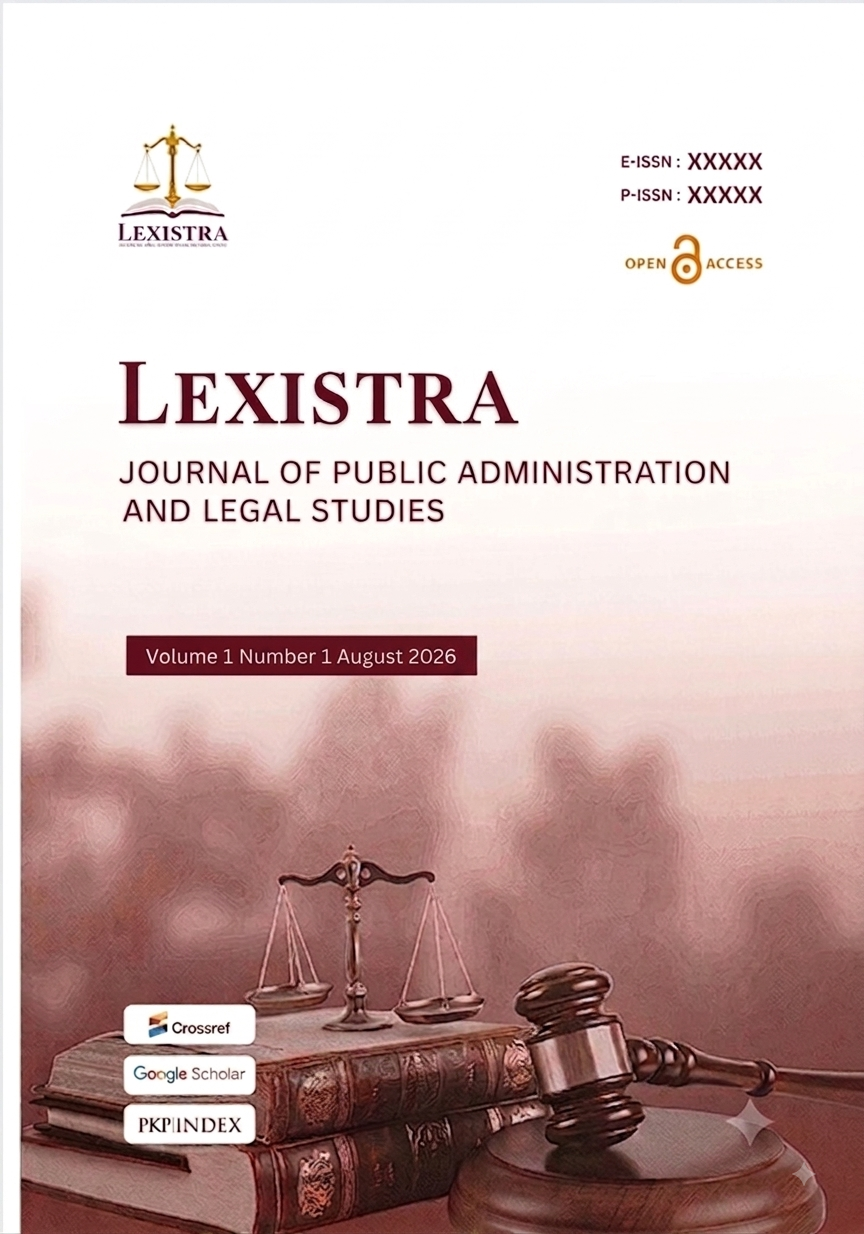
- Cover Image
-
- Downloads
- Published
- 2026-08-12
- Section
- Articles
- License
-
Copyright (c) 2026 Haryanto (Author)

This work is licensed under a Creative Commons Attribution 4.0 International License.
